
Twelve-year-old Jeremy Stone only wanted to shave a few minutes off his bike ride home. But when he cuts through the infamous Deacon’s Pass—a stretch of road shadowed by a decaying asylum and whispered legends—he sees something he was never meant to see… and leaves something behind he may never get back.
What follows is a chilling chain of events: a dead body is found, Jeremy's backpack mysteriously reappears at school, and his great-grandmother—locked away in a rehab center—begins to speak of angels and demons only she can see. As strange deaths begin to pile up and a red-haired nurse stalks the halls unseen by staff, Jeremy realizes the people society ignores might be the only ones who know the truth.
When a long-lost friend returns in a form no one could expect, Jeremy must confront not only the secrets of the asylum, but the ghosts of his past—and the monsters hiding in plain sight.
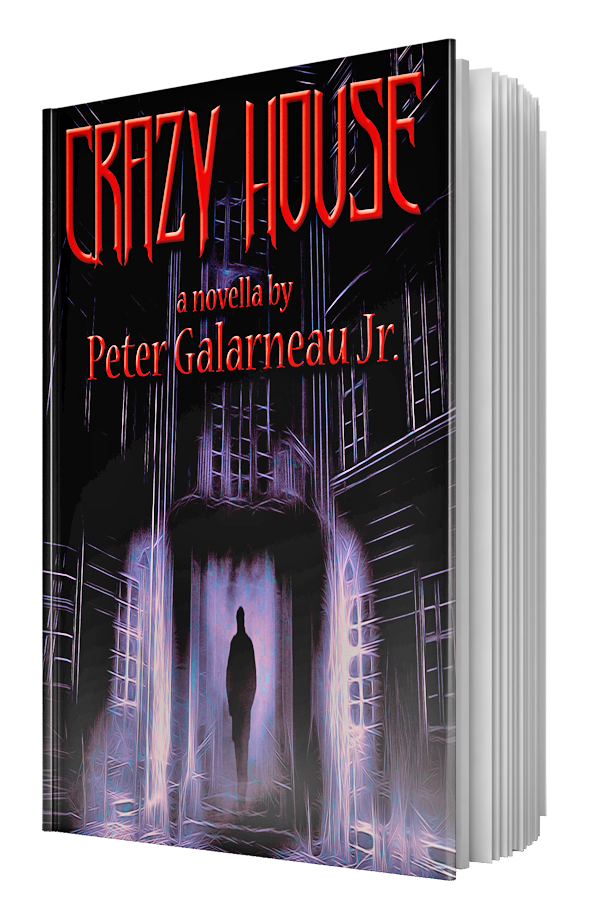
Peter Galarneau Jr.’s Crazy House is a novella that merges psychological horror, supernatural mystery, and coming-of-age realism within the emotionally fraught setting of West Virginia’s rural landscape. The novella engages with themes of trauma, familial obligation, mental health, and institutional neglect.
Through its young protagonist, Jeremy Stone, Galarneau explores the blurred line between perception and reality, using the decaying vestiges of an old asylum as both literal and symbolic terrain for confronting ghosts of the past.
Crazy House is best situated within the gothic horror tradition with strong leanings toward psychological suspense and young adult fiction. It integrates elements of supernatural horror—ghosts, apparitions, and a demon-like nurse—with real-world tragedy, such as family breakdown, elder care, and child abduction.
The novella is structured linearly, with a tight narrative arc centered around a single weekend. Despite this temporal compression, Galarneau layers the narrative with flashbacks (especially relating to Jeremy’s missing cousin Teddy) and dream sequences that enrich the psychological complexity of the text. The story’s pacing, oscillating between introspection and bursts of supernatural action, serves to maintain reader tension while reflecting Jeremy’s unstable reality.
As the central figure, Jeremy functions as both protagonist and reluctant detective. Galarneau portrays him with a psychological realism that grounds the more fantastical elements of the narrative. His struggle to navigate grief, guilt, and fear underscores the deeper emotional currents of the story.
Grammy operates as a liminal figure—between life and death, sanity and madness—providing the novella’s most chilling and poignant moments. Her deterioration and sudden lucid insights evoke not only empathy but a metaphysical unease. She also acts as a spiritual guide, warning Jeremy of the demonic forces at play and symbolizing generational wisdom under threat.
Teddy embodies unresolved trauma and symbolizes the story’s central mystery: the ungraspable nature of loss and the enduring presence of those we’ve lost.
Galarneau’s prose is deliberately restrained, drawing its horror not from grotesque spectacle but from subtle atmospheric shifts. The use of sensory detail, especially smell, positions the rehabilitation center as a kind of modern gothic asylum. Dialogue is naturalistic, particularly between Jeremy and his mother, grounding the story in believable emotional dynamics.
Galarneau employs symbolism throughout—red Jello as a metaphor for poison, the mechanical pencil as a totem of memory and identity, and the forested Roney’s Point as a landscape of buried secrets. The interplay of light and fog, especially in the scenes at Deacon’s Pass, reinforces themes of obscured truth and spectral presence.
Jeremy’s arc is classic: a boy thrust into circumstances requiring moral judgment, bravery, and ethical action. But Galarneau’s twist lies in the world’s unreliability: even adults are unable or unwilling to protect him. Growing up, in this novella, means seeing through the lies and confronting evil with only a child’s courage.
Teddy’s disappearance is the novella’s emotional nucleus. Every character action is shaped by this loss, especially Jeremy’s guilt and his mother’s overprotection. The trauma haunts the narrative like a ghost, linking psychological horror with the supernatural.
Set in rural West Virginia, Crazy House evokes a distinctly Appalachian gothic tradition, with its abandoned mental institutions, impoverished communities, and close-knit family structures. The novella indirectly critiques post-industrial decay and rural health care systems, reflecting real-world concerns about elder care, child welfare, and the erosion of trust in public institutions.
There is also a latent commentary on generational disconnection—Jeremy’s digital world (smartphones, Angry Birds) contrasts sharply with Grammy’s analog past (Thanksgiving, garden pies, World War-era resilience). Galarneau uses these contrasts to show how different generations process fear and grief.